
Academic writing is one of the most important skills you will develop during university life. Whether you are preparing a short undergraduate essay, a master’s dissertation, or a doctoral thesis, your ability to communicate ideas clearly and critically often determines the quality of your grades. Many students enter university with strong subject knowledge but still struggle to achieve high marks because they have not yet mastered academic writing conventions. The good news is that academic writing is not an innate talent reserved for a select few. It is a skill that can be learned, refined, and strengthened over time.
For students searching for practical ways of improving academic writing skills, the challenge often lies in knowing where to begin. Some students struggle with clarity and structure, while others find referencing, critical analysis, or academic vocabulary overwhelming. International students may additionally face the challenge of learning how to improve writing skills in English as a second language while adapting to UK academic expectations.
You may also read this: Academic writing: a Practical Guide
This guide explores how you can transform your writing from average to first-class standard. You will learn the principles of excellent academic writing, discover common mistakes students make, and gain practical strategies used by high-achieving students across UK universities. We will also explore exercises to improve academic writing skills, methods for developing academic confidence, and ways to strengthen your writing for essays, dissertations, and research projects.
Understanding What First-Class Academic Writing Looks Like
One of the main reasons students struggle to improve is because they are unclear about what “good academic writing” actually means. A first-class essay is not simply about using complicated words or writing lengthy paragraphs. UK universities typically assess academic writing according to several core criteria, including clarity, critical analysis, structure, evidence, originality, and referencing accuracy.
The Quality Assurance Agency (QAA) emphasises independent critical thinking as a central feature of higher education standards in the UK. This means your writing must go beyond describing information. Instead, you are expected to analyse, compare, evaluate, and construct arguments supported by credible evidence.
First-class writing demonstrates authority and precision. The argument flows logically, paragraphs are coherent, and evidence is integrated naturally into the discussion. Importantly, excellent academic writing also shows confidence without becoming overly emotional or informal.
Many students assume strong writing is primarily about grammar, but academic success depends just as much on analytical thinking and intellectual organisation. If your ideas are unclear, even perfect grammar will not produce a first-class grade.
What Are the 5 C’s of Academic Writing?
Students frequently ask, “What are the 5 C’s of academic writing?” These principles provide a useful foundation for improving academic communication.
The first is clarity. Your reader should immediately understand your point without confusion or ambiguity. Clear writing avoids unnecessary jargon and explains complex concepts effectively.
The second is conciseness. Strong academic writing communicates ideas efficiently without excessive repetition or filler language. Many students mistakenly believe longer sentences sound more intelligent, but concise writing is often more persuasive.
The third is coherence. Every paragraph should connect logically to the next, creating a smooth progression of ideas. Coherence is essential for maintaining reader engagement and demonstrating intellectual control.
The fourth is credibility. Academic arguments must be supported by reliable evidence from peer-reviewed sources, scholarly books, and reputable data.
The fifth is correctness. Grammar, punctuation, spelling, and referencing must all meet academic standards. Even excellent ideas can lose marks if technical accuracy is poor.
Together, these five principles form the backbone of high-quality academic writing.
What Are the 7 C’s of Writing Skills?
Closely related to the 5 C’s are the 7 C’s of writing skills, which are commonly taught in academic communication programmes. These include clarity, conciseness, concreteness, correctness, coherence, completeness, and courtesy.
In academic contexts, completeness is particularly important. Your argument must fully answer the essay question rather than partially addressing it. Students often lose marks because they focus heavily on one aspect of the question while ignoring others.
Concreteness also matters because vague arguments weaken academic credibility. Instead of making broad statements such as “many students struggle with writing,” stronger writing includes evidence or examples to support claims.
Understanding these principles helps students evaluate their own work more critically before submission.
The 4 Golden Rules of Academic Writing
Many academic tutors refer to four golden rules that underpin successful university writing.
The first rule is to answer the question directly. Surprisingly, one of the biggest reasons students lose marks is because they drift away from the assignment focus. Every paragraph should contribute to answering the central question.
The second rule is to support arguments with evidence. Unsupported opinions rarely carry academic value. Strong essays integrate research findings, statistics, theories, and scholarly perspectives.
The third rule is to maintain critical analysis. Descriptive writing explains what others have said; critical writing evaluates strengths, weaknesses, limitations, and implications.
The fourth rule is to reference accurately. Proper referencing not only avoids plagiarism but also strengthens the credibility of your work.
These principles may appear simple, but consistently applying them significantly improves writing quality.
Improving Academic Writing Skills for Students
Improving academic writing skills for students requires consistent practice and reflection. One of the most effective strategies is reading high-quality academic material regularly. Exposure to journal articles, dissertations, and scholarly books helps students internalise academic tone, sentence structure, and argument development.
Students at universities such as the University of Oxford and University of Cambridge are often encouraged to analyse published academic papers not only for content but also for writing style. Paying attention to how scholars introduce arguments, integrate evidence, and structure discussions can dramatically improve your own writing abilities.
Another highly effective method involves rewriting weak paragraphs. Instead of merely proofreading grammar, students should examine whether their writing demonstrates analysis, coherence, and logical flow.
For example, consider the following average sentence:
“Social media affects students in many ways.”
A stronger academic version might read:
“Recent studies suggest that excessive social media usage negatively affects students’ concentration, academic productivity, and mental wellbeing.”
The second sentence is more precise, evidence-oriented, and analytical.
How to Improve Academic Writing Skills in English
For international students, learning how to improve writing skills in English as a second language can feel particularly challenging. However, many ESL students achieve outstanding academic results by focusing on gradual improvement rather than perfection.
One useful approach is developing an academic vocabulary bank. Instead of memorising random advanced words, focus on discipline-specific terminology and transition phrases commonly used in academic essays. Words such as “consequently”, “however”, “moreover”, and “nevertheless” improve cohesion and sophistication when used naturally.
Reading academic texts aloud can also strengthen sentence rhythm and grammatical awareness. Additionally, students should avoid overusing translation software, as direct translations often produce unnatural phrasing.
UK universities increasingly provide academic writing support centres where international students can receive personalised feedback. Seeking feedback early is one of the fastest ways to improve.
Improving Academic Writing Skills Essay Strategies
When writing essays, structure is everything. A well-organised essay demonstrates intellectual clarity before the marker even evaluates the argument itself.
Strong essays generally follow a logical progression:
- Introduction
- Main discussion paragraphs
- Critical evaluation
- Conclusion
However, structure alone is insufficient. Each paragraph should contain a clear topic sentence, supporting evidence, analysis, and a concluding link back to the argument.
Many students weaken their essays by summarising sources rather than analysing them. Critical analysis means asking deeper questions. For example:
- What are the limitations of this theory?
- How reliable is this evidence?
- Does another scholar disagree?
- Are there methodological weaknesses?
These evaluative elements separate average essays from first-class work.
As discussed in our guide to choosing a dissertation topic, developing analytical thinking early makes dissertation writing significantly easier later in your academic journey.
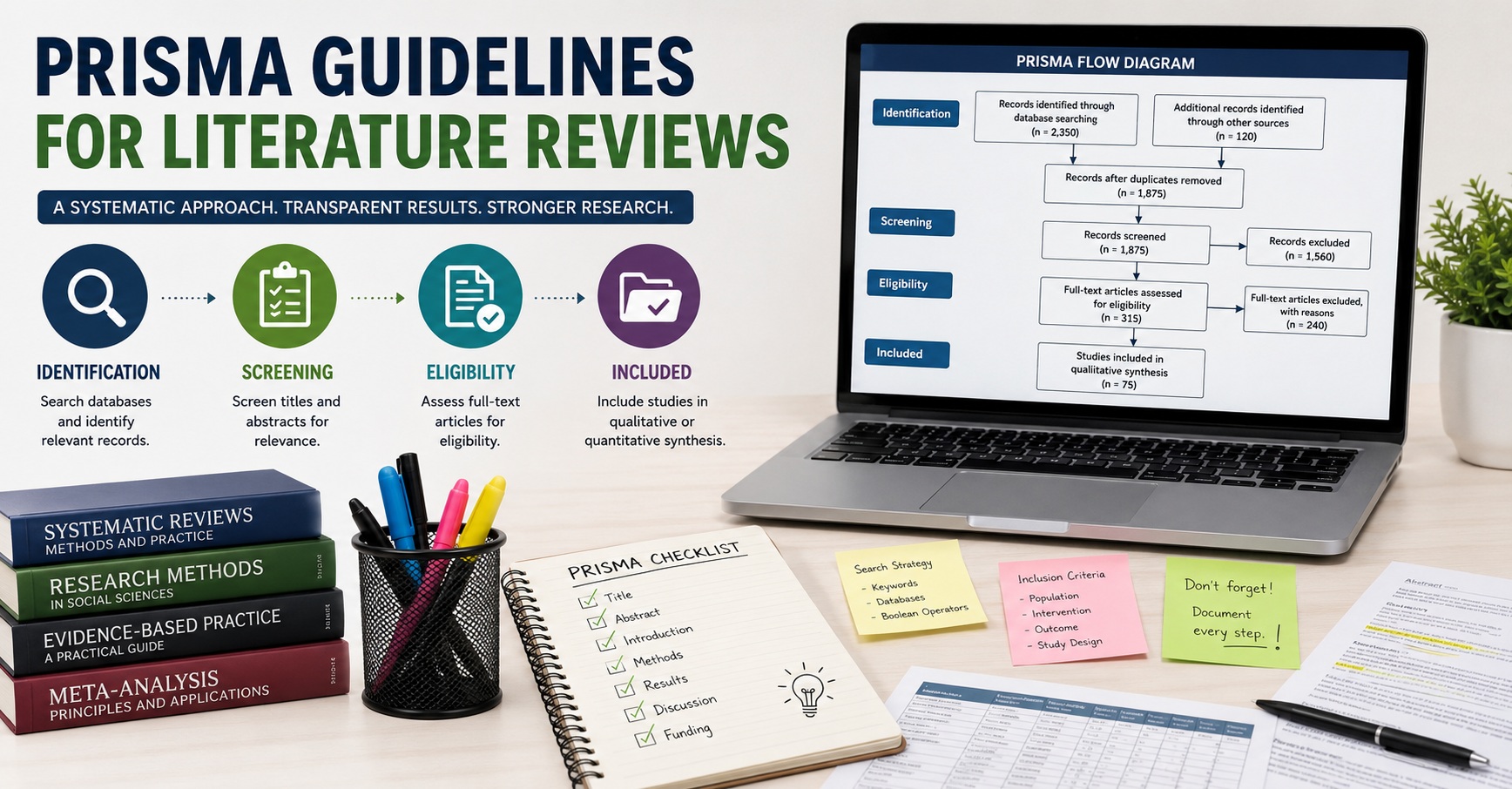
Using PRISMA Guidelines for Literature Reviews
One increasingly valuable skill in academic writing is conducting systematic and structured literature reviews. Students working on dissertations or research projects often encounter the challenge of organising large volumes of literature effectively.
This is where Using PRISMA Guidelines for Literature Reviews: A Step-by-Step Checklist with Examples becomes highly relevant. The PRISMA framework helps researchers improve transparency, consistency, and methodological rigour in literature reviews.
Using PRISMA encourages students to document how studies were identified, selected, and analysed. This not only strengthens research credibility but also improves academic writing clarity because arguments become more systematic and evidence-driven.
For postgraduate students conducting dissertations, learning structured review techniques can significantly improve both writing quality and research confidence.
Exercises to Improve Academic Writing Skills
Academic writing improves through active practice rather than passive reading alone. One of the most effective exercises involves summarising journal articles in your own words. This strengthens comprehension, paraphrasing skills, and analytical thinking simultaneously.
Another useful exercise is reverse outlining. After completing a draft, write a one-sentence summary beside each paragraph explaining its purpose. This quickly reveals structural weaknesses, repetition, or unclear arguments.
Timed writing exercises are also beneficial. Many students struggle because they spend too long editing individual sentences instead of developing ideas fluently. Short writing sessions help build confidence and reduce perfectionism.
Students can additionally benefit from peer review groups where essays are exchanged for constructive feedback. Often, another reader can identify unclear arguments more easily than the writer themselves.
Common Academic Writing Mistakes Students Make
Even strong students frequently make avoidable writing mistakes. One common issue is overly descriptive writing. Simply explaining theories or summarising articles does not demonstrate critical engagement.
Another major problem is weak paragraph structure. Long paragraphs containing multiple unrelated ideas often confuse readers and weaken coherence.
Poor referencing is another recurring issue. Inconsistent citation formatting can reduce marks and raise academic integrity concerns. Students should carefully follow university-approved referencing styles such as Harvard, APA, or OSCOLA.
Many students also struggle with confidence. They assume academic writing must sound overly complex, resulting in awkward or unnatural sentences. In reality, clarity and precision are far more valuable than forced sophistication.
Improving Academic Writing Skills for Adults
Mature students returning to education often worry that their writing skills are outdated. However, improving academic writing skills for adults is entirely achievable with the right strategies and support.
Adult learners often possess strong life experience, critical thinking abilities, and discipline that younger students may lack. The main challenge usually involves adapting to current academic conventions and digital research tools.
Setting realistic goals is important. Rather than attempting immediate perfection, focus on gradual improvements in structure, referencing, and analytical depth. Many mature students benefit greatly from university writing workshops and online academic support resources.
Importantly, academic writing is not about age. It is about practice, reflection, and willingness to improve.
The Role of Feedback in Academic Improvement
One of the fastest ways to improve writing is learning how to use feedback effectively. Unfortunately, many students glance at tutor comments only briefly before moving on to the next assignment.
Feedback should instead be treated as a personalised improvement roadmap. If multiple assignments mention weak analysis or unclear structure, this reveals recurring patterns that need attention.
High-achieving students actively analyse feedback trends and apply them consistently across future work. This reflective approach often produces dramatic grade improvements over time.
At Dissertation Writing UK, we regularly encourage students to maintain a “feedback journal” where common tutor comments are recorded alongside strategies for improvement.
Technology and Academic Writing in Modern Universities
Digital tools are increasingly shaping academic writing practices across UK higher education. Grammar checkers, reference management software, and AI-assisted research tools can all support students when used responsibly.
However, technology should never replace independent critical thinking. Universities remain highly focused on originality, analytical depth, and academic integrity.
Tools such as referencing software can save time, but students must still understand citation principles themselves. Likewise, grammar tools can improve readability, but they cannot substitute genuine critical engagement with research.
The most successful students use technology as support rather than dependency.
Building Long-Term Academic Confidence
Ultimately, improving academic writing is not only about achieving higher grades. It is about developing intellectual confidence and communication skills that remain valuable long after university.
Strong academic writing improves employability, research capability, and professional communication across numerous careers. Employers consistently value graduates who can analyse information critically and present ideas clearly.
The journey from average to first-class writing rarely happens overnight. It involves continuous learning, regular practice, constructive feedback, and resilience. Every strong academic writer was once a beginner.
The key is consistency.
Conclusion
Improving academic writing skills is one of the most valuable investments you can make during your university education. Whether you are struggling with essay structure, critical analysis, academic English, or dissertation writing, progress is entirely achievable through focused practice and strategic improvement.
Understanding the 5 C’s of academic writing, applying the 7 C’s of writing skills, following the four golden rules of academic writing, and engaging critically with research can dramatically transform the quality of your work. Equally important is developing confidence in your own academic voice.
From using structured frameworks such as PRISMA guidelines to practising targeted writing exercises and learning from feedback, every improvement contributes to stronger academic performance and greater intellectual independence.
If you ever feel overwhelmed during your academic journey, seeking guidance from experienced academic professionals can provide valuable clarity and support. Universities across the UK increasingly encourage students to access academic writing assistance, workshops, and mentoring as part of their learning development.