
Introduction
If you are asking How to prepare for a viva voce?, you are certainly not alone. For many master’s and PhD students across UK universities, the viva voce is often viewed as the most intimidating stage of the academic journey. After spending months — and sometimes years — researching, analyzing data, and writing your dissertation, the thought of defending your work in front of expert examiners can feel overwhelming.
The concern is understandable. Unlike written assessments, a viva examines not only your research but also your understanding, critical thinking ability, and confidence in discussing your work. Many students worry about difficult questions, forgetting important points, or not knowing how to respond if challenged. Yet despite these concerns, a viva is not designed to “catch you out”. Instead, it provides an opportunity to demonstrate your expertise and explain the thinking behind your research decisions.
Across many UK institutions, viva expectations align with principles of academic quality assurance and research standards that focus on originality, methodological understanding, and contribution to knowledge. The purpose is not perfection; it is evidence of scholarly competence.
Students also read about : How to Write a Dissertation : A Complete Step-by- Step Guide for UK Students
This guide explores how to prepare for a viva voce in a practical and realistic way. You will learn what a viva actually involves, how UK universities approach the process, effective preparation techniques, common mistakes to avoid, and strategies that help students enter the room feeling prepared rather than fearful.
Understanding the Viva Voce Process in UK Universities
Before preparing for your viva, it helps to understand exactly what you are preparing for.
The term viva voce comes from Latin and means “with the living voice”. In UK higher education, particularly for postgraduate research degrees, it refers to an oral examination where you discuss and defend your dissertation or thesis with examiners.
Students also read about :Common Dissertation Pitfalls And How to Avoid Them
Typically, a PhD viva in the UK includes an internal examiner and an external examiner. Master’s dissertation viva may vary depending on institutional policy. The duration can range from one hour to several hours depending on the subject area and complexity of the research.
Your examiners may ask questions about:
- Your research aims and objectives
- The rationale behind your topic choice
- Methodology and research design
- Literature review findings
- Data analysis and interpretation
- Limitations of the study
- Contribution to existing research
- Future research recommendations
Students often imagine the process as a hostile debate. In reality, examiners usually aim to understand your reasoning and determine whether you genuinely own and understand the research presented.
Why Students Feel Nervous About the Viva
Many students experience anxiety because the viva differs from traditional assessments.
During your dissertation journey, you work independently for months. Suddenly, you are expected to discuss every aspect of your work in real time. Unlike written work, there is no opportunity to revise an answer after speaking.
Another common issue is uncertainty. Students frequently ask:
“What if I forget something?”
“What if they find weaknesses?”
“What if I cannot answer a question?”
These concerns are entirely normal. In fact, many experienced supervisors report that highly capable students often experience more stress because they care deeply about the quality of their work.
Understanding that nervousness is expected can help reduce unnecessary pressure.
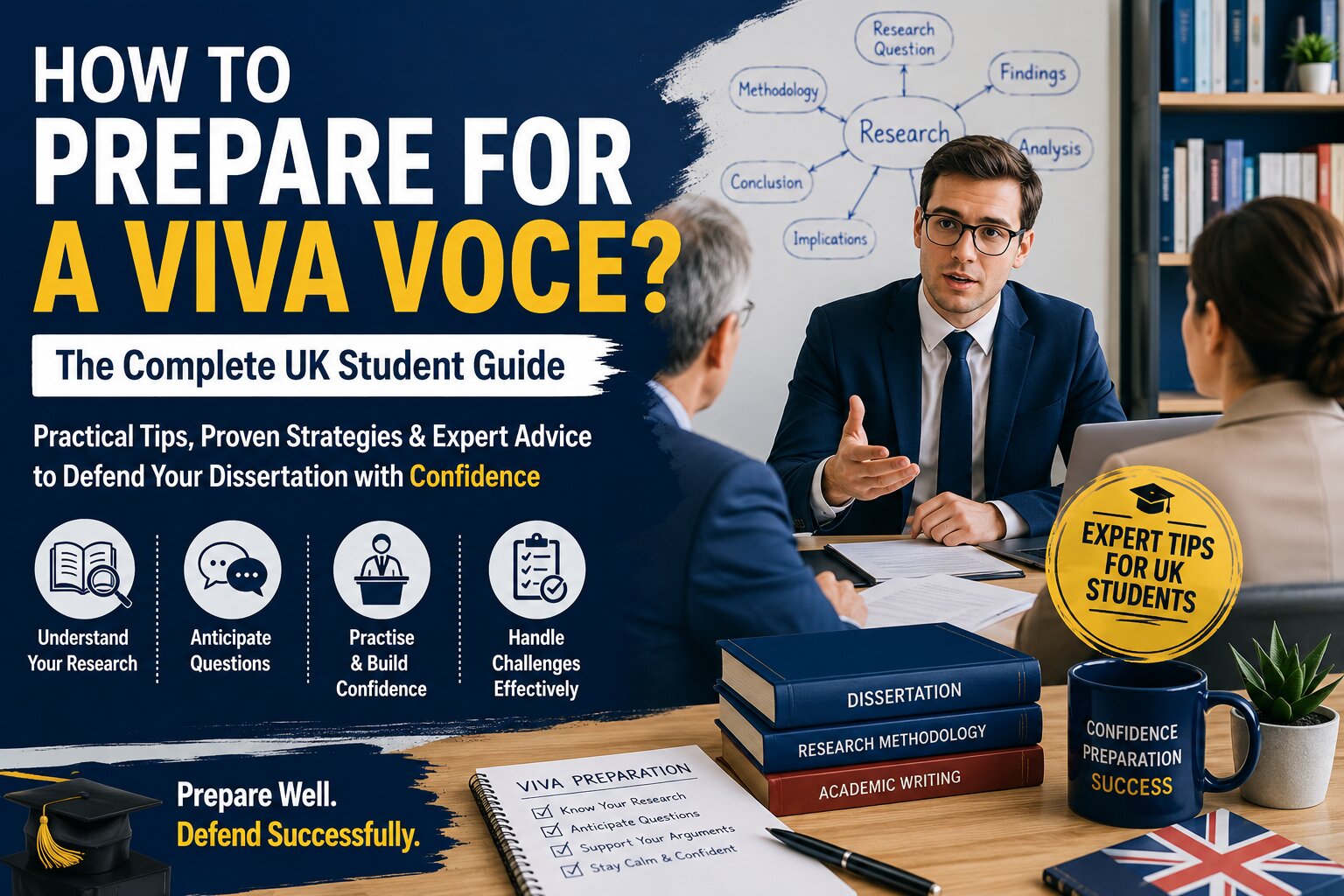
How to Prepare for a Viva Voce by Knowing Your Dissertation Inside Out
One of the biggest misconceptions about viva preparation is assuming that you need to memorize every sentence in your dissertation.
You do not.
Instead, you need a deep understanding of your research decisions and arguments.
After submitting a dissertation, many students deliberately avoid reading it because they feel exhausted. Unfortunately, this can create problems later.
Re-read your dissertation carefully and focus on understanding:
Research Objectives and Questions
You should be able to explain exactly what your study aimed to investigate and why it matters.
For example, if your dissertation explored social media marketing strategies among UK businesses, be ready to discuss why the topic was relevant and how your objectives addressed existing research gaps.
Methodology Choices
Examiners frequently ask:
“Why did you choose qualitative research?”
“Why use interviews rather than surveys?”
“Why was your sample size appropriate?”
Your goal is not to defend the methodology as perfect but to justify why it was suitable.
Key Findings and Interpretation
Knowing your findings is not enough. You should understand what those findings actually mean and how they connect to previous research.
Creating an Effective Viva Preparation Strategy
Students preparing for a dissertation often search for guidance on how to write a dissertation, but preparing for the final defences requires a different approach.
Effective preparation involves active engagement rather than passive reading.
Consider creating a summary document that includes:
- Main research aims
- Core arguments
- Important findings
- Key theories
- Strengths and limitations
- Potential examiner questions
This condensed document becomes a quick revision resource.
Some students create color-coded notes or visual mind maps to connect different sections of their research. Choose whichever approach helps you recall information naturally.
Preparing for Common Viva Questions
Although no viva is identical, certain questions appear frequently across UK institutions.
Examples include:
“Can you summarize your thesis in two minutes?”
“Why did you select this research topic?”
“What is the original contribution of your research?”
“What would you change if you repeated the study?”
“What are the limitations of your research?”
“How does your work fit into existing literature?”
Preparing structured responses helps significantly.
For instance, if asked about limitations, avoid sounding defensive.
Instead of saying:
“There were no limitations.”
You might say:
“The study was limited by time constraints and sample size, which may affect wider generalizability. However, measures were implemented to strengthen validity through….”
This demonstrates maturity and critical awareness.
Mock Viva Can Transform Confidence
One of the most effective preparation methods is participating in a mock viva.
A mock viva recreates the examination experience and allows you to practice speaking about your research aloud.
Many students discover something interesting during mock sessions: they know far more than they realize.
Speaking aloud identifies:
Areas where explanations are unclear
Sometimes concepts that appear obvious in writing become difficult to explain verbally.
Knowledge gaps
You may notice sections that need further revision.
Communication habits
Some students speak too quickly, provide excessively long answers, or avoid eye contact.
Practicing improves all of these areas.
As we discussed in our guide to choosing a dissertation topic and our article on UK dissertation structure, academic success depends not only on knowledge but also on presenting that knowledge effectively.
Practical Example: A Student Case Study
Consider Sarah, a hypothetical master’s student studying business management at a UK university.
Sarah completed a dissertation exploring consumer behavior in online retail markets. While her written work received positive supervisor feedback, she felt anxious about the viva.
Rather than repeatedly reading her dissertation, she adopted a structured preparation strategy.
She:
- Created chapter summaries
- Listed possible examiner questions
- Practiced with peers
- Recorded herself answering questions
- Reviewed methodological decisions
During her viva, one examiner challenged her sample size choice.
Instead of becoming defensive, Sarah explained the practical limitations, justified her approach with relevant methodology literature, and acknowledged areas for future improvement.
Her result included only minor corrections.
The key lesson is that successful students rarely know every answer perfectly; they demonstrate thoughtful reasoning.
Common Challenges Students Face During Viva Preparation
Even with careful preparation, difficulties can arise.
Fear of Difficult Questions
Students often assume difficult questions indicate failure.
This is rarely true.
Examiners frequently ask challenging questions to explore your thinking rather than expose weaknesses.
If you do not know an answer, it is acceptable to say:
“That is an interesting point. I had not considered that perspective fully, but based on my findings…”
Thoughtful responses are stronger than rushed guesses.
Imposter Syndrome
Many postgraduate students experience feelings of inadequacy.
You may think:
“I am not an expert.”
Yet remember something important: you have spent months researching a highly specific topic.
In many ways, you may know more about your particular research area than anyone else in the room.
Managing Stress Before the Viva
Preparation helps reduce anxiety, but wellbeing also matters.
Try to maintain:
- Consistent sleep patterns
- Regular meals
- Moderate exercise
- Reasonable study breaks
Attempting to revise continuously the night before your viva rarely improves performance.
Current Trends in UK Higher Education and Viva Expectations
Higher education continues to evolve across the UK.
Increasing emphasis is being placed on research transparency, ethical practices, critical thinking, and interdisciplinary perspectives. Universities increasingly encourage researchers to explain not only what they did but also why they made particular decisions.
Students are also using digital tools and AI-supported research technologies more frequently. However, examiners may ask questions regarding originality, ethical use of technology, and independent contribution.
This means you should be prepared to discuss how your research process was conducted and how academic integrity was maintained.
How Dissertation Writing Support Can Help Students Prepare
Many students seek guidance during different stages of their academic journey. Some require support understanding how to write a dissertation, while others look for best dissertation help UK resources to strengthen research quality and preparation strategies.
Professional academic guidance does not replace your work or your ideas. Instead, it can help clarify structure, strengthen critical thinking, and identify areas requiring further development.
At Dissertation Writing UK, students often seek support not simply for writing but for understanding the entire dissertation journey — from selecting a topic to preparing confidently for final assessment stages.
Conclusion
Learning how to prepare for a viva voce is ultimately about preparation, familiarity, and confidence rather than memorization.
Know your dissertation thoroughly. Understand the reasoning behind your decisions. Practice discussing your work aloud. Anticipate common questions and recognize that limitations do not weaken your research — they demonstrate critical awareness.
Remember that your viva is not an interrogation. It is a conversation about work you have already spent considerable time creating.
If you are approaching your dissertation journey and need guidance on research planning, structuring your work, or understanding academic expectations within UK higher education, seeking professional support can provide valuable direction and reassurance.
Success in a viva is rarely about knowing everything. It is about demonstrating that you understand your work and can discuss it thoughtfully.